
Contents
Overview
The concept of Blitzkrieg, or "lightning war," has roots in 19th-century Prussian military strategy, notably influenced by Carl von Clausewitz's theories on the "concentration principle" and the _Schwerpunkt_ (center of gravity). However, its modern application emerged in the interwar period, driven by advancements in tank and aircraft technology. German military theorists like Hans von Seeckt, constrained by the Treaty of Versailles, emphasized speed and mobility, even experimenting with mock tanks and secret training in the Soviet Union. This evolution culminated in its first significant, albeit unofficial, use during the Spanish Civil War, paving the way for its devastating effectiveness in World War II, as documented by historians like Karl-Heinz Frieser.
💥 How It Works
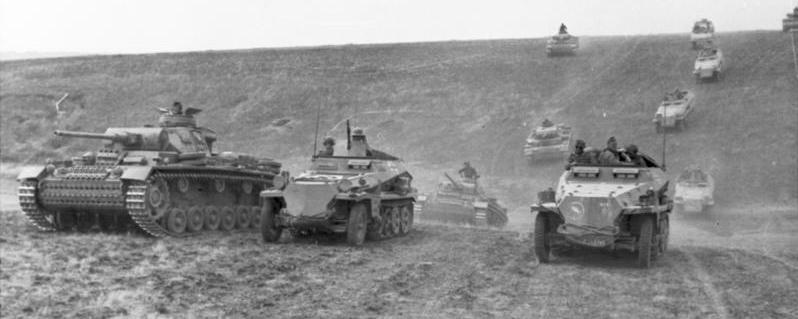
Blitzkrieg is a coordinated military effort designed to create psychological shock and disorganization in enemy forces through surprise, speed, and overwhelming firepower. It involves concentrating armored and motorized infantry formations, supported by artillery and close air support, to break through enemy lines. The objective is to dislocate defenders, confuse the enemy with a rapidly changing front, and achieve a decisive _Vernichtungsschlacht_ (battle of annihilation). This tactic relies on deep penetrations, bypassing strongpoints to encircle and destroy opposing forces in a _Kesselschlacht_ (cauldron battle), a concept refined by figures like Heinz Guderian and Erwin Rommel.
🌍 Cultural Impact
The term "Blitzkrieg" gained widespread recognition through Western media, particularly American journalists, following the German invasion of Poland in 1939 and the swift fall of France in 1940. While Nazi propaganda embraced the term, it was never an official military doctrine of the Wehrmacht; Hitler himself reportedly called it an "idiotic word." Despite this, the tactic's psychological impact was immense, contributing to the perception of German invincibility in the early years of World War II. The terror bombing of London, known as "The Blitz," also became synonymous with this aggressive warfare style, impacting civilian morale and drawing ordinary people into the conflict.
🚀 Legacy & Future
While Blitzkrieg proved highly effective in the initial stages of World War II, its limitations became apparent against well-organized defenses and in prolonged campaigns, such as the invasion of the Soviet Union. The Allies, including figures like U.S. General George Patton, eventually adapted and employed similar maneuver warfare tactics. The concept of Blitzkrieg continues to influence modern military strategy, demonstrating the enduring importance of speed, coordination, and combined arms in achieving decisive battlefield outcomes, as seen in later conflicts like the Six-Day War and the Persian Gulf War.
Key Facts
- Year
- 1930s-1940s
- Origin
- Germany
- Category
- history
- Type
- concept
Frequently Asked Questions
What does "Blitzkrieg" mean?
"Blitzkrieg" is a German word that literally translates to "lightning war" or "lightning attack." It describes a military tactic characterized by speed and overwhelming force.
Who developed Blitzkrieg tactics?
While the term "Blitzkrieg" was popularized by journalists, its roots lie in the theories of Carl von Clausewitz and the practical developments by German military leaders like Hans von Seeckt, Heinz Guderian, and Erwin Rommel in the interwar period and during World War II.
What were the key components of Blitzkrieg?
Blitzkrieg involved the coordinated use of armored vehicles, motorized infantry, artillery, and close air support to achieve rapid breakthroughs, deep penetrations, and encirclements of enemy forces, aiming for psychological shock and rapid victory.
Was Blitzkrieg an official German military doctrine?
No, "Blitzkrieg" was not an official military doctrine of the Wehrmacht. While the tactics were employed, the term itself was largely a journalistic label, and even Adolf Hitler reportedly disliked it.
How did Blitzkrieg influence later warfare?
Blitzkrieg's emphasis on speed, surprise, and combined arms significantly influenced modern military strategy. Its principles have been adapted and employed by various armies in subsequent conflicts, demonstrating its lasting impact on battlefield tactics.
References
- en.wikipedia.org — /wiki/Blitzkrieg
- encyclopedia.ushmm.org — /content/en/article/blitzkrieg-lightning-war
- britannica.com — /topic/blitzkrieg
- history.com — /articles/blitzkrieg
- worldhistory.org — /Blitzkrieg/
- merriam-webster.com — /dictionary/blitzkrieg
- fr.wikipedia.org — /wiki/Blitzkrieg
- iwm.org.uk — /history/blitzkrieg-explained