
Contents
Overview
The genesis of the Chemical Weapons Convention (CWC) can be traced back to the devastating use of chemical agents like mustard gas and phosgene during World War I. Subsequent efforts, including the 1925 Geneva Protocol, sought to ban the use of chemical weapons, but they often lacked robust verification mechanisms and did not prohibit development or production. The Cold War arms race, however, spurred significant advancements in chemical warfare capabilities by both the United States and the Soviet Union, creating an urgent need for a comprehensive ban. Negotiations for the CWC began in earnest in 1980 within the United Nations Conference on Disarmament in Geneva, involving extensive diplomatic efforts and compromises between major powers and non-aligned nations. The treaty was finally opened for signature in Paris on January 13, 1993, and entered into force on April 29, 1997, after ratification by the required 65 states, marking a pivotal moment in global arms control.
⚙️ How It Works
The CWC operates through a multi-layered verification regime designed to ensure compliance and build confidence among its state parties. Its central pillar is the Organisation for the Prohibition of Chemical Weapons (OPCW), which conducts on-site inspections of declared facilities, including chemical weapons production sites, storage depots, and research laboratories. States parties are obligated to declare all relevant activities and facilities, and the OPCW employs a range of inspection types, from routine inspections to challenge inspections, which can be requested by any state party if they suspect non-compliance. The convention also mandates the destruction of all declared chemical weapons stockpiles and production facilities, a process that is meticulously monitored by OPCW inspectors. Furthermore, the CWC regulates the production and trade of certain 'dual-use' chemicals that could be diverted for weapons purposes, requiring states to report on their production and trade of these substances above specified thresholds.
📊 Key Facts & Numbers
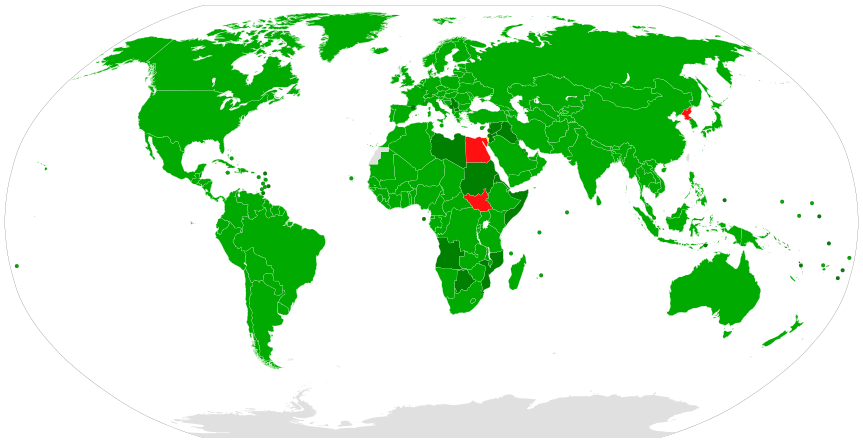
As of August 2022, 193 states have ratified the Chemical Weapons Convention, representing near-universal adherence to its prohibitions. This includes all 30 member states of the NATO alliance and the 12 member states of the European Union. The OPCW has verified the destruction of over 98% of the world's declared chemical weapons stockpiles, totaling more than 72,000 metric tons of chemical agents. However, challenges remain: approximately 1,000 metric tons of chemical weapons are yet to be destroyed, and the OPCW has documented 22 instances of chemical weapons use in Syria since 2014, underscoring the ongoing threat. The convention's budget for 2023 was approximately €70 million, funding its extensive verification and disarmament activities.
👥 Key People & Organizations
The Organisation for the Prohibition of Chemical Weapons (OPCW) serves as the implementing body for the CWC, headquartered in The Hague, Netherlands. Its Director-General, currently Fernando Arias, oversees the organization's operations, including inspections and verification activities. Key figures instrumental in the CWC's negotiation and early implementation include Joseph Neal Boyle, who chaired the UN Conference on Disarmament's Ad Hoc Committee on Chemical Weapons, and Jayantha Dharmasena, a former OPCW Director-General who played a crucial role in overseeing large-scale destruction operations. Major state parties like the United States and Russia, which declared the largest stockpiles, have been central to the destruction process, while organizations such as the Arms Control Association have been vocal advocates for strengthening the convention's implementation and addressing emerging threats.
🌍 Cultural Impact & Influence
The Chemical Weapons Convention has profoundly reshaped the global security landscape by stigmatizing chemical warfare and creating a robust international norm against these abhorrent weapons. Its near-universal adherence has significantly reduced the likelihood of state-sponsored chemical attacks, fostering a sense of collective security. The OPCW's verification activities have not only ensured disarmament but also promoted transparency and trust among nations, contributing to broader disarmament efforts. The convention's success has also influenced the development of other arms control treaties, such as the Biological Weapons Convention, by providing a model for verification and enforcement. Culturally, the CWC has reinforced the idea that certain weapons are beyond the pale of civilized warfare, influencing public opinion and political discourse on weapons of mass destruction.
⚡ Current State & Latest Developments
The CWC continues to grapple with evolving threats, particularly the use of novel chemical agents and the potential for non-state actors to acquire or develop chemical weapons. The OPCW is actively working to address these challenges, including enhancing its capabilities to investigate alleged uses of chemical weapons and to monitor the proliferation of dual-use chemicals. The ongoing destruction of remaining stockpiles, particularly in Russia and the United States, remains a critical focus, with the OPCW providing technical assistance and verification. Furthermore, the convention is adapting to new technological advancements, such as the use of artificial intelligence in chemical analysis and verification, to stay ahead of potential evasions. The OPCW's recent investigations into alleged chemical weapons use in Syria highlight the persistent difficulties in achieving full accountability and disarmament in complex conflict zones.
🤔 Controversies & Debates
One of the most persistent controversies surrounding the CWC involves allegations of non-compliance and the challenges of verification, especially concerning states suspected of maintaining undeclared chemical weapons programs. The Syrian government's repeated alleged use of chemical weapons, despite being a party to the CWC, has severely tested the convention's credibility and the OPCW's enforcement mechanisms. Debates also arise regarding the interpretation of 'chemical weapons' and 'precursors,' particularly concerning dual-use chemicals and emerging technologies that blur the lines between legitimate industrial use and weapons development. Furthermore, the process of destroying large stockpiles is technically complex and expensive, leading to discussions about the timeline and the allocation of resources for disarmament efforts, especially when faced with new security threats.
🔮 Future Outlook & Predictions
The future of the Chemical Weapons Convention hinges on its ability to adapt to new technological advancements and geopolitical realities. Experts predict a continued focus on addressing the proliferation of dual-use chemicals and the potential for non-state actors to weaponize readily available substances. The OPCW is likely to invest further in advanced verification technologies, including remote sensing and data analytics, to enhance its monitoring capabilities. There is also a growing emphasis on strengthening international cooperation and information sharing to prevent the diversion of chemicals for illicit purposes. The long-term goal remains the complete elimination of chemical weapons, but achieving this will require sustained political will, adequate funding, and robust enforcement mechanisms to deter any potential resurgence of chemical warfare.
💡 Practical Applications
The primary practical application of the Chemical Weapons Convention is the verifiable destruction of chemical weapons stockpiles and production facilities. This process involves highly specialized engineering and safety protocols to neutralize toxic agents safely, often utilizing incineration or chemical neutralization technologies. Beyond disarmament, the CWC has significant implications for the global chemical industry. Companies producing or trading certain scheduled chemicals are subject to declaration and reporting requirements to the OPCW, ensuring transparency and preventing diversion. This regulatory framework impacts research and development in areas like pharmaceuticals and materials science, w
Key Facts
- Category
- technology
- Type
- topic