
Contents
Overview
The conceptual roots of continuity strategies can be traced back to ancient military and civic planning, where societies developed methods to maintain order and essential services during sieges or natural calamities. However, the formalization of business continuity planning (BCP) as a distinct discipline gained significant traction in the mid-20th century, spurred by the Cold War's existential threats and the increasing reliance on complex technological systems. Early BCP efforts, often referred to as 'disaster recovery planning,' primarily focused on IT infrastructure recovery after catastrophic events. The evolution from simple disaster recovery to comprehensive business continuity strategies reflects a growing understanding of interconnected risks and the need for holistic organizational preparedness, moving beyond IT to encompass all critical business functions.
⚙️ How It Works
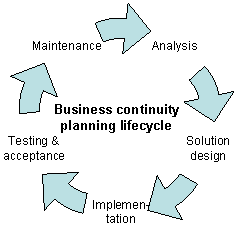
At its core, a continuity strategy involves a cyclical process of identifying critical business functions, assessing potential threats and vulnerabilities, developing mitigation and response plans, and regularly testing and updating these plans. This typically begins with a business impact analysis (BIA) to quantify the potential consequences of disruption to each business process, establishing recovery time objectives (RTOs) and recovery point objectives (RPOs). Based on the BIA, strategies are designed, which might include redundant systems, off-site data backups, alternative work locations, and pre-established communication protocols with stakeholders. The ISO 22301 standard, for instance, provides a framework for implementing and maintaining a business continuity management system (BCMS), guiding organizations through the entire lifecycle of planning, implementation, and continuous improvement, ensuring that recovery plans are not static but dynamic and responsive to evolving threats.
📊 Key Facts & Numbers
Globally, it's estimated that over 80% of organizations have some form of business continuity plan in place, though the maturity and effectiveness of these plans vary wildly. The average cost of downtime for a small business can exceed $120,000 per day, while for large enterprises, this figure can skyrocket into millions. A 2023 report by Gartner indicated that only about 20% of organizations feel 'very confident' in their business continuity capabilities. Furthermore, cyberattacks alone cost the global economy an estimated $10.5 trillion annually by 2025, underscoring the immense financial imperative for robust continuity strategies. The Federal Emergency Management Agency (FEMA) in the U.S. also highlights that over 40% of businesses that experience a disaster never reopen, a stark statistic emphasizing the life-or-death importance of preparedness.
👥 Key People & Organizations
Key figures in the development of continuity strategies include George W. Booth, often credited with early BCP methodologies, and Robert McCall Jr., a significant contributor to the Business Continuity Institute. Major organizations like the Disaster Recovery Institute International (DRI International) and the Business Continuity Institute (BCI) are central to setting standards, providing certifications, and fostering professional development in the field. Technology giants like IBM and Microsoft offer solutions and consulting services that underpin many continuity strategies, particularly in the realm of cloud-based disaster recovery and data resilience. Government agencies such as FEMA and the UK's National Cyber Security Centre also play critical roles in setting guidelines and promoting preparedness, especially concerning national security and critical infrastructure.
🌍 Cultural Impact & Influence
Continuity strategies have profoundly shaped organizational culture, moving resilience from an IT-specific concern to a boardroom-level imperative. The widespread adoption of BCP has fostered a more risk-aware mindset across industries, influencing everything from product development cycles to employee training. The 'always-on' expectation fostered by digital transformation means that continuity is no longer about recovering from a disaster, but about ensuring seamless, uninterrupted service delivery, a concept deeply embedded in the ethos of platforms like AWS and Google Cloud. This cultural shift has also led to increased demand for professionals with expertise in business continuity and resilience, creating a dedicated career path and influencing academic curricula in business and IT management programs worldwide.
⚡ Current State & Latest Developments
The current landscape of continuity strategies is heavily influenced by the rapid acceleration of digital transformation and the increasing sophistication of threats. Cloud computing has revolutionized disaster recovery, offering scalable and cost-effective solutions for data backup and application failover, as exemplified by AWS's disaster recovery options and Azure's Site Recovery services. However, this reliance on interconnected digital systems also introduces new vulnerabilities, particularly in cybersecurity, with ransomware attacks becoming a primary driver for BCP updates. The COVID-19 pandemic also forced a significant re-evaluation of continuity plans, highlighting the need for strategies that address widespread, long-term disruptions and remote work enablement, a shift that continues to shape planning in 2024 and beyond.
🤔 Controversies & Debates
One of the most persistent controversies in continuity strategies revolves around the balance between preparedness and cost. Critics argue that many organizations over-invest in elaborate plans that are rarely tested or may never be needed, while proponents contend that the cost of inaction during a major disruption far outweighs the investment in preparedness. Another debate centers on the definition and measurement of 'resilience' versus 'continuity,' with some experts advocating for a more proactive, adaptive approach that embraces change rather than solely focusing on recovery. Furthermore, the ethical implications of prioritizing certain business functions or customer segments over others during a crisis remain a contentious issue, particularly in public services and critical infrastructure.
🔮 Future Outlook & Predictions
The future of continuity strategies will likely be defined by the integration of artificial intelligence (AI) and machine learning (ML) for predictive threat analysis and automated response. Expect to see more sophisticated 'self-healing' systems that can detect and mitigate disruptions in real-time, minimizing downtime before it even occurs. The concept of 'continuous availability' will become the norm, pushing beyond traditional RTOs and RPOs towards near-zero downtime. Additionally, as climate change intensifies, strategies will need to incorporate more robust plans for environmental disruptions, such as extreme weather events, and address the growing interconnectedness of global supply chains, making resilience a truly global concern. The rise of quantum computing also poses future challenges and opportunities for data security and recovery protocols.
💡 Practical Applications
Continuity strategies are not confined to large corporations; they are vital for businesses of all sizes. Small businesses can implement cost-effective continuity plans by leveraging cloud services for data backup and utilizing Google Workspace or Microsoft 365 for collaboration and communication continuity. For IT departments, continuity strategies translate into implementing robust backup and recovery solutions, redundant infrastructure, and failover mechanisms. In healthcare, continuity plans are critical for ensuring patient care during emergencies, involving backup power, redundant communication systems, and plans for staff availability. Event organizers utilize continuity strategies to manage unforeseen issues like venue problems or performer cancellations, ensuring events can proceed with minimal disr
Key Facts
- Category
- philosophy
- Type
- topic