
Contents
Overview
The intellectual lineage of dynamical systems theory traces back to the 17th century with Isaac Newton's laws of motion, which described the predictable evolution of celestial bodies using differential equations. However, the formalization of DST as a distinct field gained momentum in the late 19th and early 20th centuries, spurred by mathematicians like Henri Poincaré, who explored the qualitative behavior of solutions to differential equations, particularly in celestial mechanics. His work on the three-body problem highlighted the inherent unpredictability in seemingly deterministic systems. Later, Aleksandr Lyapunov's work on stability laid crucial groundwork for understanding system behavior around equilibrium points. The mid-20th century saw the emergence of chaos theory, a subfield of DST, with seminal contributions from Edward Lorenz and his discovery of the butterfly effect in weather models, demonstrating how sensitive dependence on initial conditions could lead to apparent randomness in deterministic systems. This period also saw the development of discrete dynamical systems, particularly through the work of Stanislaw Ulam and John von Neumann on cellular automata and computation.
⚙️ How It Works
At its heart, DST models systems whose state changes over time according to fixed rules. The core objective is not always to find exact solutions for the system's state over time, but rather to understand the qualitative behavior: where do systems tend to go over long periods (attractors)? Are these behaviors stable or unstable? How does the system's behavior change qualitatively as parameters are varied (bifurcations)? The theory often employs geometric intuition, visualizing flows and transformations within phase space.
📊 Key Facts & Numbers
Dynamical systems theory underpins models that predict phenomena across vast scales. The global weather system, a prime example of a chaotic dynamical system, exhibits sensitivity where a change of 0.0001 degrees Celsius in initial temperature can lead to drastically different weather patterns weeks later. The human heart's electrical activity, modeled by systems like the FitzHugh-Nagumo model, involves complex feedback loops. The logistic map x_{n+1} = r x_n (1 - x_n) can exhibit over 100 distinct periodic orbits and chaotic behavior for different values of r.
👥 Key People & Organizations
Key figures in DST include Henri Poincaré, whose work on the three-body problem in the late 19th century revealed the limits of predictability in classical mechanics. Aleksandr Lyapunov developed crucial stability criteria in the early 20th century. Edward Lorenz is credited with discovering chaos theory, coining the term 'butterfly effect'. Mitchell Feigenbaum later elucidated universal scaling laws in chaotic systems. Stephen Smale made significant contributions to the geometric theory of dynamical systems, including the 'Smale horseshoe' mapping. Organizations like the American Mathematical Society and the Society for Industrial and Applied Mathematics (SIAM) host conferences and publish journals that are central to DST research, such as the SIAM Journal on Applied Dynamical Systems. Research groups at institutions like MIT, Princeton University, and Cambridge University remain at the forefront of theoretical and applied DST.
🌍 Cultural Impact & Influence
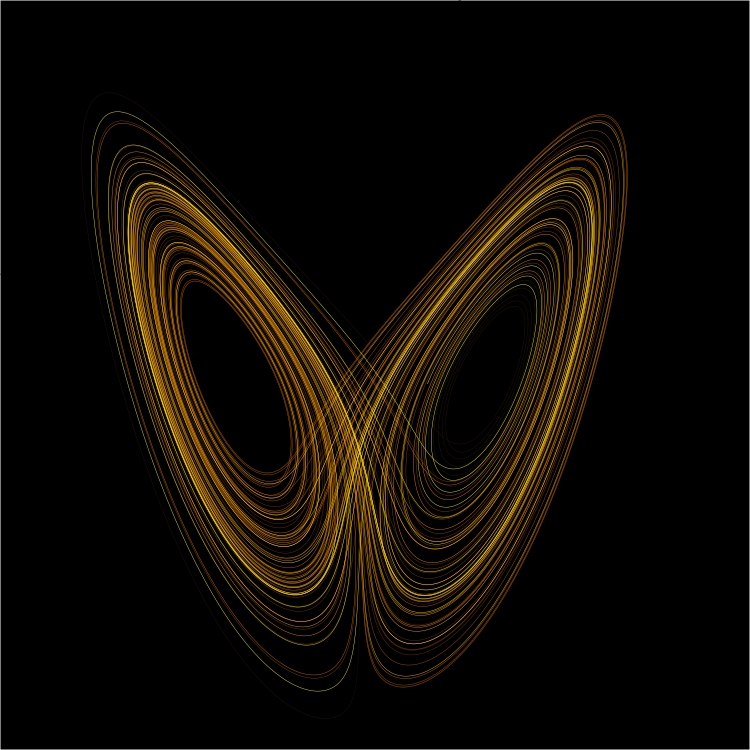
Dynamical Systems Theory has profoundly shaped our understanding of the natural and artificial world, moving beyond purely reductionist views to embrace complexity and emergent behavior. Its concepts have permeated fields from physics and engineering to biology and economics. The idea of the 'butterfly effect' has entered popular culture, symbolizing how small causes can have large, unpredictable effects, influencing everything from environmental policy discussions to narrative structures in film. In biology, DST models have revolutionized our understanding of population dynamics, epidemic spread (e.g., SIR models), and neural networks. The visualization of attractors, like the Lorenz attractor, has become iconic, representing the beauty and complexity inherent in deterministic chaos. DST provides a common language for scientists across disciplines, enabling cross-pollination of ideas and fostering interdisciplinary research on topics like climate change and financial stability.
⚡ Current State & Latest Developments
The field of DST is currently experiencing a surge in activity, driven by advances in computational power and the availability of vast datasets. Researchers are developing new methods for identifying and analyzing attractors in high-dimensional data, such as those generated by large-scale simulations of galaxies or biological systems. There's a growing focus on 'data-driven' DST, where models are learned directly from observations rather than solely from first principles. Emerging areas include the study of stochastic dynamical systems (systems influenced by random noise) and the application of DST to quantum mechanics and quantum computing. The development of new visualization tools and software libraries, like Python's DynamicalSystems.jl package, is also accelerating research and accessibility.
🤔 Controversies & Debates
A central debate within DST revolves around the nature of predictability in chaotic systems. While DST demonstrates that deterministic rules can lead to inherent unpredictability beyond a certain time horizon due to sensitivity to initial conditions, the extent to which this limits practical forecasting remains contentious. Critics argue that some systems, often labeled 'chaotic,' might be more predictable than theory suggests, or that simplified models fail to capture crucial stabilizing factors. Another controversy lies in the application of DST to social and economic systems; critics question whether these systems are truly deterministic or if they are fundamentally influenced by factors beyond mathematical modeling, such as human agency and exogenous shocks. The interpretation of 'attractors' in complex, noisy data also sparks debate, with disagreements over whether observed patterns represent true mathematical attractors or merely statistical correlations. The philosophical implications of determinism versus free will, particularly in light of chaotic dynamics, continue to be a subject of ongoing discussion.
🔮 Future Outlook & Predictions
The future of Dynamical Systems Theory appears robust, with increasing integration into emerging technologies and scientific frontiers. We can expect DST to play a critical role in developing more accurate climate models, predicting the behavior of complex biological systems like the human brain and immune system, and designing more resilient infrastructure. The application of DST to artificial intelligence, particularly in areas like reinforcement learning and generative models, will likely deepen. Researchers are exploring how DST can help us understand and control emergent phenomena in complex networks, from social networks to power grids. There's also a push towards developing more general theories that can unify continuous, discrete, and stochastic dynamics, potentially leading to a more comprehensive framework for understanding all forms of change. Predictions suggest that within the next decad
Key Facts
- Category
- science
- Type
- topic