
Contents
Overview
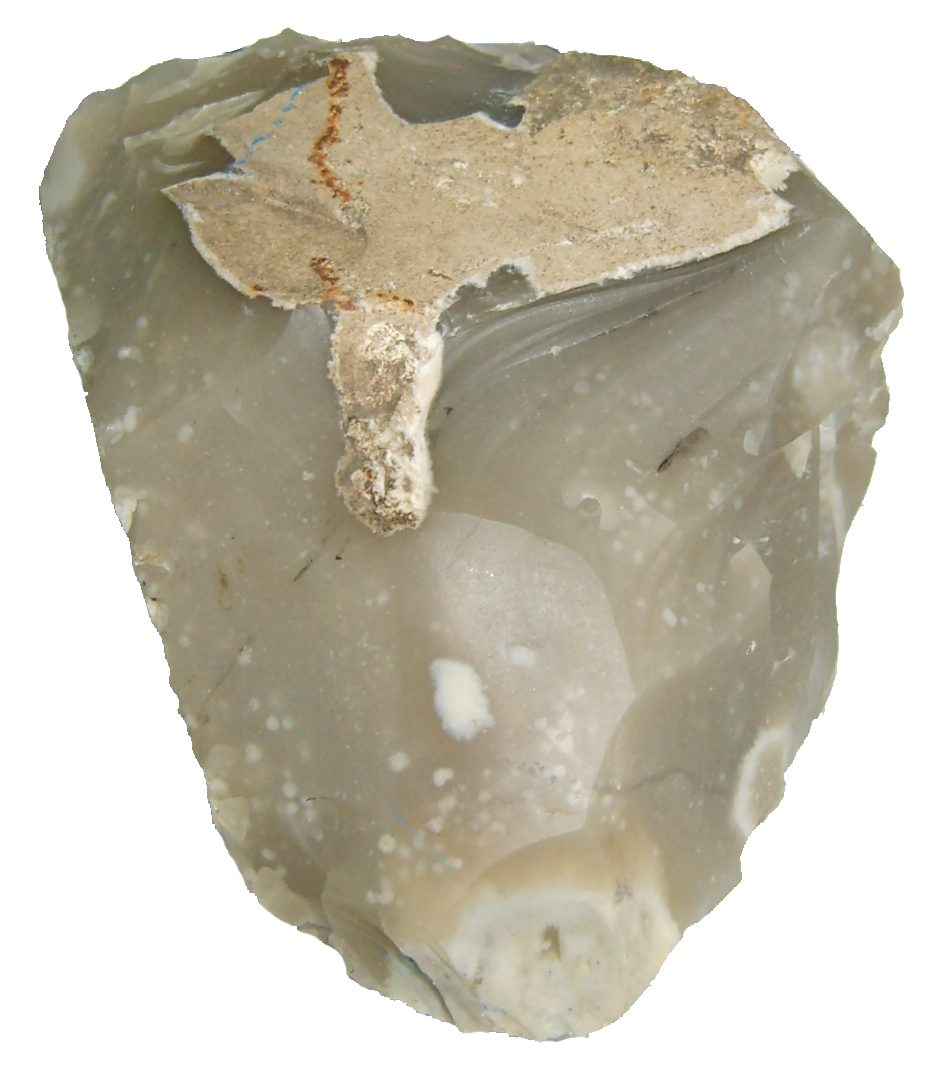
Flint's story begins in the deep past, with its formation as nodules within chalk and marly limestone deposits. Its true historical significance, however, is tied to the earliest hominins. Archaeological evidence suggests the use of flint for toolmaking dates back at least 3.3 million years, with early hominids like Australopithecus sediba and Homo habilis likely utilizing naturally fractured pieces. The deliberate knapping of flint to create sharp edges for cutting, scraping, and piercing marked a pivotal step in human evolution, enabling survival through hunting and food processing. The discovery that striking flint against iron pyrites or steel could produce sparks revolutionized fire-making, leading to the development of the flintlock in the 17th century, a technology that remained dominant in firearms until the mid-19th century. This dual utility—as a cutting tool and a fire-starter—cemented flint's status as a cornerstone material for prehistoric and early historic human civilization.
⚙️ How It Works
The utility of flint lies in its unique physical properties, primarily its hardness and its tendency to fracture in a predictable, conchoidal manner. As a cryptocrystalline variety of quartz, flint possesses a Mohs hardness of approximately 7, making it significantly harder than most common rocks. When subjected to focused force, such as by a hammerstone, flint breaks with smooth, curved surfaces, creating exceptionally sharp edges. This controlled fracturing, known as knapping, allowed early humans to fashion sophisticated tools like hand axes, scrapers, and arrowheads. The spark-generating capability arises from the friction and heat produced when flint is struck against a harder, ferrous material like steel. The sharp edges of the flint shear off tiny particles of the steel, which oxidize rapidly in the air, generating visible sparks. This process, refined over millennia, was crucial for warmth, cooking, and defense.
📊 Key Facts & Numbers
Flint deposits are found globally, with significant occurrences in regions like the White Cliffs of Dover in England, the Paris Basin in France, and the Flint Hills of Kansas in the United States. The oldest known flint tools, discovered at the Lomekwi 3 site in Kenya, date back to approximately 3.3 million years ago, predating the Homo genus. The widespread use of flint for tools is evidenced by millions of artifacts found across continents. The flintlock mechanism, a key application, was the primary ignition system for firearms from the mid-17th century until the development of the percussion cap around 1820, meaning it was in widespread military use for over 200 years. Modern industrial uses, such as in lighter flints, consume an estimated several thousand tons of processed flint annually.
👥 Key People & Organizations
While flint itself is a geological material, its history is intertwined with key figures and cultural developments. Early hominins, though unnamed, are the original 'users' of flint. Later, the development of advanced knapping techniques is attributed to various prehistoric cultures, including the Acheulean and Mousterian industries. In the context of firearms, inventors like Marin le Bourgeoys are credited with significant refinements to the flintlock mechanism in the early 17th century. Organizations like the Smithsonian Institution and the British Museum house vast collections of flint artifacts, providing crucial insights into early human technology. Geologists and archaeologists worldwide, such as Mary Leakey and Louis Leakey, have dedicated careers to studying the provenance and use of flint in ancient contexts.
🌍 Cultural Impact & Influence
Flint's influence on human civilization is profound and multifaceted. Its availability and ease of shaping into sharp tools were fundamental to the survival and expansion of early human populations, enabling advancements in hunting, butchery, and craft. The development of fire-starting technologies based on flint provided warmth, protection, and the ability to cook food, which is believed to have played a role in human brain development. The flintlock mechanism revolutionized warfare and hunting, impacting political power structures and colonial expansion for centuries. The term 'flinty' has entered the lexicon to describe a person with a determined, unyielding character, reflecting the stone's own unyielding nature. The very concept of a 'stone age' is inextricably linked to the widespread use of materials like flint.
⚡ Current State & Latest Developments
In contemporary times, flint's role has shifted from a primary tool material to a more specialized resource. While traditional flintknapping is practiced by hobbyists and archaeologists for research and demonstration, its industrial applications persist. Processed flint is still a key component in the flints used in cigarette lighters and some gas stoves, manufactured by companies like Bic and Zippo. Geologists continue to study flint formations for insights into ancient environments and for their role in the Cretaceous geological record. Efforts to preserve significant geological sites, such as the Flint Hills National Natural Landmark in Kansas, highlight the ongoing appreciation for these natural resources.
🤔 Controversies & Debates
One persistent debate surrounds the precise origins of the earliest deliberate flint tool manufacture. While Lomekwi 3 in Kenya currently holds the record for the oldest known tools at 3.3 million years, some researchers question whether these represent true 'toolmaking' or simply the opportunistic use of naturally fractured stones. Another area of contention involves the exact chemical and physical processes that lead to flint formation within chalk and limestone matrices, with ongoing research refining our understanding of diagenesis and silica diagenesis. Furthermore, the historical attribution of specific flint tool technologies, like the Clactonian industry, to particular hominin species remains an active area of archaeological discussion and revision.
🔮 Future Outlook & Predictions
The future of flint likely lies in continued scientific research and niche industrial applications. Geologists will continue to analyze flint deposits for paleoclimatic data and to understand the complex processes of sedimentary rock formation. In industry, the demand for flint as a spark-generating material in lighters and igniters is expected to remain stable, though potentially declining with the rise of electronic ignition systems. There's also a growing interest in flintknapping as a heritage craft and a method for experimental archaeology, potentially leading to new artistic expressions and a deeper understanding of prehistoric capabilities. The potential for discovering even older flint tool sites remains, promising to push back the timeline of human technological innovation.
💡 Practical Applications
Flint's practical applications are diverse, spanning from ancient survival to modern conveniences. Its most iconic use was in crafting tools for cutting, scraping, and piercing, essential for hunting, preparing food, and creating shelters. The ability to generate sparks made it indispensable for fire-starting, a critical technology for warmth, cooking, and protection. In the realm of weaponry, the flintlock mechanism was a dominant ignition system for firearms for over two centuries, profoundly impacting military history. Today, processed flint is a key component in the flints found in disposable lighters, such as those made by Bic, and in gas stove igniters. It is also used in some industrial grinding media and as a decorative aggregate in landscaping.
Key Facts
- Category
- nature
- Type
- topic