
Contents
Overview
The concept of Earth possessing a magnetic field dates back to the 16th century with observations by William Gilbert, who proposed in his 1599 treatise De Magnete that Earth itself acted as a giant magnet. However, the scientific explanation for how this field is generated remained elusive for centuries. Early 20th-century physicists like Joseph Larmor (1919) and Walter Elsasser (1930s) began formulating theories involving electrical currents within the Earth's core. The modern understanding of the geodynamo, as a self-sustaining process driven by convection in a rotating, conductive fluid, solidified through the work of scientists like Edward Bullard and H. Charles Whelan in the 1950s, who developed mathematical models that could reproduce key features of the geomagnetic field.
⚙️ How It Works
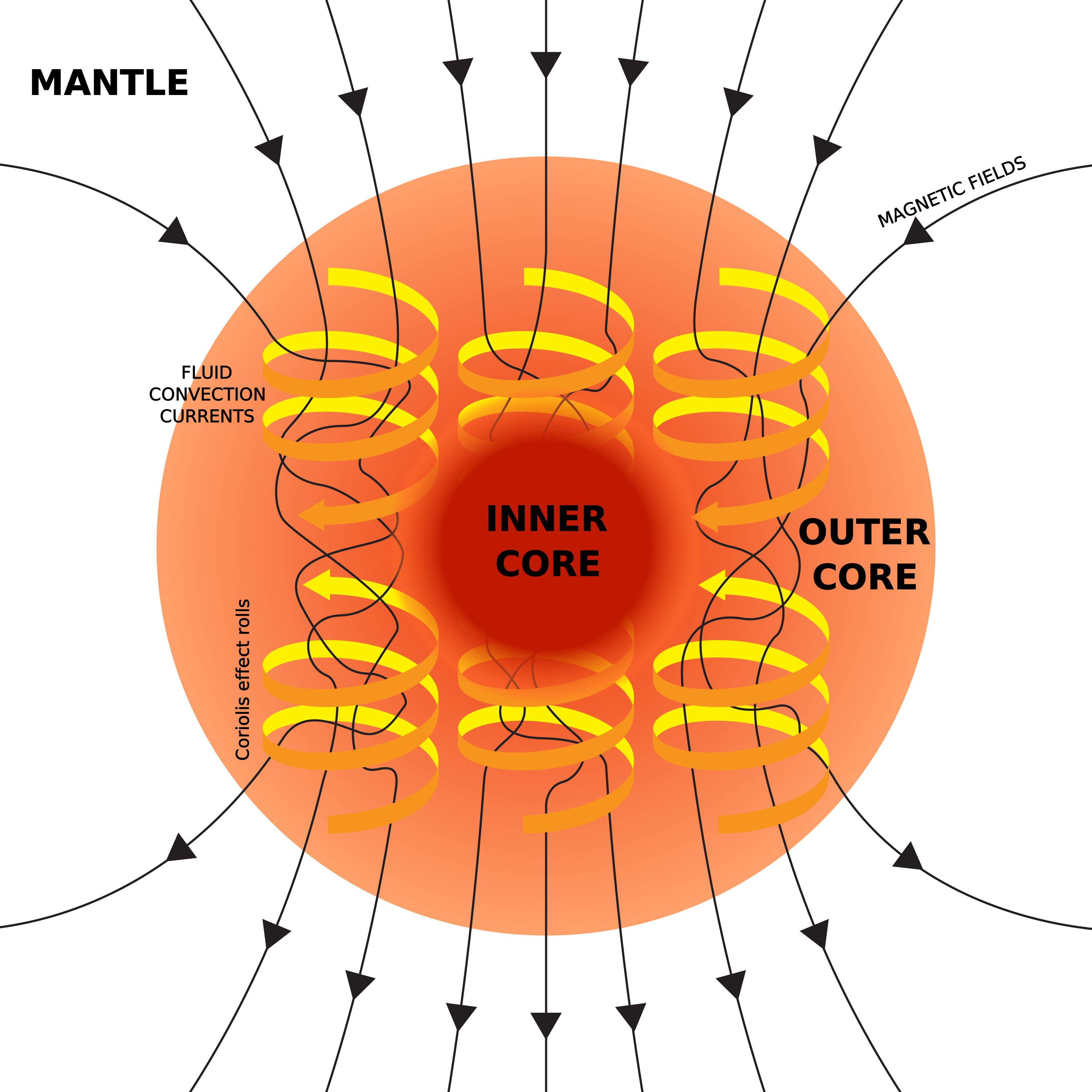
The geodynamo operates on the principle of a magnetohydrodynamic dynamo. Within Earth's outer core, a vast ocean of molten iron and nickel churns due to heat escaping from the solid inner core and the decay of radioactive elements. This convective motion, coupled with the Coriolis force from Earth's rotation, twists and stretches magnetic field lines. As the conductive fluid moves, it generates electrical currents, which in turn create their own magnetic fields. This feedback loop, where fluid motion generates magnetic fields and magnetic fields influence fluid motion, allows the geodynamo to sustain Earth's magnetic field over geological timescales, a process akin to how an electric generator works but on a planetary scale.
📊 Key Facts & Numbers
Earth's magnetic field extends approximately 60,000 kilometers (37,000 miles) into space, forming the magnetosphere. The field's strength varies, averaging around 30 to 60 microteslas (0.3 to 0.6 gauss) at the surface, but it's not uniform and fluctuates over time. Geomagnetic reversals occur where the north and south magnetic poles swap places, an event that has occurred hundreds of times in Earth's history, with the last full reversal happening about 780,000 years ago. The energy driving the geodynamo is estimated to be around 10 terawatts, primarily from thermal convection and compositional convection (the release of lighter elements like sulfur and silicon as the inner core solidifies).
👥 Key People & Organizations
Key figures in understanding the geodynamo include William Gilbert, who first proposed Earth was a magnet; Walter Elsasser, who developed early theoretical models; Edward Bullard, who formulated a foundational mathematical model; and David Stewart-Atherton, whose work on dynamo theory contributed significantly. Modern research heavily involves computational geophysicists at institutions like the University of California, Berkeley, the University of Cambridge, and the Geophysical Institute in Greece, utilizing supercomputers to simulate core dynamics. Organizations like the United States Geological Survey and the European Geosciences Union play crucial roles in monitoring and disseminating data on Earth's magnetic field.
🌍 Cultural Impact & Influence
The geodynamo's influence is profound, shaping life on Earth by deflecting the solar wind and cosmic rays that would otherwise strip away our atmosphere and pose a severe radiation hazard. This protective shield has been instrumental in the evolution of life, making Earth habitable. Beyond its biological necessity, the magnetic field has guided human exploration and navigation for centuries, from early mariners using compasses to modern GPS systems that rely on accurate geomagnetic data. The phenomenon of auroras (Northern and Southern Lights) is a direct visual manifestation of the interaction between the solar wind and Earth's magnetosphere, a testament to the geodynamo's power and reach.
⚡ Current State & Latest Developments
Current research into the geodynamo is heavily focused on improving the fidelity of numerical simulations, aiming to accurately predict the behavior of Earth's magnetic field, including the timing and nature of future reversals. Scientists are also investigating the role of inner core dynamics and the precise composition of the outer core, particularly the influence of lighter elements. Recent studies, such as those published in journals like Nature Geoscience and Science, are using advanced seismic imaging techniques to probe the core's structure and infer flow patterns. The ongoing monitoring of magnetic field variations by observatories worldwide, including the NOAA National Geophysical Data Center, provides real-time data for these investigations.
🤔 Controversies & Debates
A central debate revolves around the precise mechanisms driving convection in the outer core. While thermal convection (heat transfer) is widely accepted, the exact contribution of compositional convection (driven by the solidification of the inner core) and its role in sustaining the dynamo, especially during periods of reduced thermal flux, is still debated. Another controversy concerns the predictability of geomagnetic reversals; while paleomagnetic records show they are irregular, some models suggest potential underlying patterns that are not yet fully understood. The exact physical processes at the Earth-inner-core boundary remain a significant area of contention among geophysicists.
🔮 Future Outlook & Predictions
The future of geodynamo research promises more sophisticated computational models capable of simulating longer timescales and higher resolutions, potentially leading to more accurate predictions of magnetic field behavior, including the timing and intensity of future reversals. Scientists are also exploring the possibility of using machine learning algorithms to analyze vast datasets from geomagnetic observatories and paleomagnetic records to identify subtle precursors to reversals. Furthermore, advancements in mineral physics and high-pressure experiments may shed light on the core's material properties, refining our understanding of the fluid dynamics at play. The long-term prospect includes a more robust understanding of how planetary magnetic fields evolve and whether they are essential for habitability across the galaxy.
💡 Practical Applications
Understanding the geodynamo has direct practical applications in several fields. Accurate models of Earth's magnetic field are essential for GPS and satellite navigation, as well as for protecting satellites and infrastructure from geomagnetic storms. The study of paleomagnetism—the record of Earth's past magnetic fields preserved in rocks—allows scientists to reconstruct continental drift, study past climate, and date geological formations. Furthermore, the principles of dynamo theory are applied in designing and building terrestrial dynamos for electricity generation and in understanding magnetic phenomena in other celestial bodies, aiding in the search for exoplanets with potentially protective magnetic fields.
Key Facts
- Category
- science
- Type
- concept