
Contents
Overview
The conceptual roots of supply and demand stretch back centuries, with early observations by thinkers like Ibn Khaldun in the 14th century noting the relationship between price and availability. However, it was Adam Smith who most famously articulated the concept of the 'invisible hand' in his 1776 magnum opus, The Wealth of Nations, suggesting that individual self-interest in a free market could lead to collective societal benefit through the natural balancing of supply and demand. Later, Léon Walras formalized this in his general equilibrium theory in the late 19th century, demonstrating how multiple markets could simultaneously reach equilibrium. Alfred Marshall's work further refined and popularized the graphical representation of supply and demand curves, solidifying its place as a cornerstone of neoclassical economics.
⚙️ How It Works
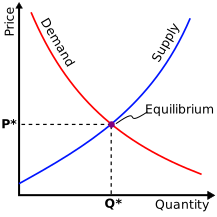
At its core, the law of supply and demand operates through the interaction of two key forces. The demand curve illustrates that as the price of a good decreases, consumers will generally wish to purchase more of it, assuming all other factors remain constant (ceteris paribus). Conversely, the supply curve shows that as the price of a good increases, producers are typically willing to supply a greater quantity, as higher prices offer greater profit potential. The point where these two curves intersect on a graph represents the market equilibrium price and quantity. If the price is above equilibrium, a surplus occurs, pushing prices down. If the price is below equilibrium, a shortage arises, driving prices up. This constant push and pull ensures that resources are allocated efficiently in a competitive market, guiding producers on what to make and consumers on what to buy.
📊 Key Facts & Numbers
The global market for goods and services governed by supply and demand is staggering in scale. For instance, the global smartphone market sees prices fluctuate based on the introduction of new models (shifting supply) and consumer desire for the latest features (shifting demand). Similarly, the price of crude oil can swing by billions of dollars in a single day due to geopolitical events affecting supply or economic forecasts influencing demand. Even seemingly niche markets, like the collectible Pokémon card market, demonstrate these principles, with rare cards commanding thousands of dollars due to limited supply and high collector demand, while common cards trade for pennies.
👥 Key People & Organizations
While Adam Smith laid much of the groundwork, numerous economists have contributed to the understanding of supply and demand. Alfred Marshall is credited with the graphical representation and integration of supply and demand into a coherent framework. John Maynard Keynes, though often associated with macroeconomics, also analyzed the role of aggregate supply and demand in national economies. In the corporate world, companies like Amazon and Walmart are masters of managing supply chains and understanding consumer demand to optimize pricing and inventory. Google's advertising platform, Google Ads, directly uses supply and demand principles to set the price of ad placements based on advertiser bids (supply) and user engagement (demand).
🌍 Cultural Impact & Influence
The law of supply and demand has permeated global culture and discourse, becoming a shorthand for how markets function. It's frequently invoked in discussions about everything from housing prices and gasoline costs to the value of cryptocurrencies. The concept has influenced political ideologies, with proponents of laissez-faire economics championing its efficiency and critics pointing to its potential to exacerbate inequality. The phrase 'supply and demand' itself has entered the vernacular, often used to explain price changes in everyday situations, demonstrating its deep integration into public understanding of economic forces.
⚡ Current State & Latest Developments
In the current economic climate of 2024, the law of supply and demand is being tested by unprecedented factors. Global supply chains, still recovering from the COVID-19 pandemic, face disruptions from geopolitical tensions in regions like Eastern Europe and the Middle East, impacting the supply of critical goods from semiconductors to agricultural products. Simultaneously, shifts in consumer behavior, driven by inflation and changing preferences for sustainable products, are altering demand patterns. Central banks worldwide, like the Federal Reserve and the European Central Bank, are actively manipulating interest rates to influence aggregate demand, attempting to steer economies away from both runaway inflation and deep recessions, showcasing the ongoing relevance and complexity of these fundamental principles.
🤔 Controversies & Debates
One of the most persistent debates surrounding the law of supply and demand centers on its applicability in markets that are not perfectly competitive. Critics argue that the model breaks down when monopolies, oligopolies, or significant information asymmetry exist, allowing firms to manipulate prices rather than simply respond to market forces. For instance, pharmaceutical companies holding patents for life-saving drugs can charge exorbitant prices due to limited supply and inelastic demand, a scenario far removed from the idealized competitive market. Furthermore, the model's assumption of rational actors is often challenged, with behavioral economics highlighting how psychological factors can lead to demand and supply decisions that deviate from pure economic logic, as seen in speculative bubbles like the dot-com bubble.
🔮 Future Outlook & Predictions
Looking ahead, the law of supply and demand will continue to be shaped by technological advancements and global challenges. The rise of automation and AI is poised to dramatically alter supply-side dynamics across numerous industries, potentially leading to increased efficiency and lower production costs, but also raising concerns about job displacement. On the demand side, growing global populations and increasing affluence in developing nations will likely drive demand for resources like energy and food, while climate change concerns may shift consumer preferences towards greener alternatives, creating new market opportunities and challenges. The ability of markets to adapt to these complex, interconnected forces will determine future economic stability and growth.
💡 Practical Applications
The law of supply and demand is not merely an abstract economic theory; it has tangible applications everywhere. In real estate, it dictates housing prices based on the number of available homes versus the number of interested buyers in a specific city. For agricultural products, farmers use their understanding of seasonal supply and consumer demand to decide what crops to plant and when to bring them to market. The stock market itself is a massive, real-time demonstration, where the price of stocks fluctuates based on the supply of shares available and the demand from investors. Even in the gig economy, platforms like Uber use dynamic pricing (surge pricing) that directly reflects the immediate supply of drivers versus the demand for rides in a particular area.
Key Facts
- Category
- economics
- Type
- topic