
Contents
- 🎵 Origins & History
- ⚙️ How It Works
- 📊 Key Facts & Numbers
- 👥 Key People & Organizations
- 🌍 Cultural Impact & Influence
- ⚡ Current State & Latest Developments
- 🤔 Controversies & Debates
- 🔮 Future Outlook & Predictions
- 💡 Practical Applications
- 📚 Related Topics & Deeper Reading
- Frequently Asked Questions
- References
- Related Topics
Overview
The concept of membrane fouling isn't a singular invention but rather an emergent challenge that has shadowed the development of filtration technologies since their inception. Early filtration attempts, dating back to ancient civilizations using porous materials like sandstone or cloth for basic purification, likely encountered rudimentary forms of clogging. However, the modern understanding of membrane fouling truly began to crystallize with the advent of synthetic membranes in the mid-20th century. Pioneers like Siegfried Loeb and John Sutherland Reid, who developed the Loeb-Reid process for creating reverse osmosis membranes in the 1960s at UCLA, immediately grappled with the practical limitations imposed by fouling. As membrane processes like microfiltration, ultrafiltration, and reverse osmosis became more sophisticated and commercially viable through companies like Dow Water Solutions (now DuPont Water Solutions) and Parker Hannifin, the economic and operational impact of fouling became a central research focus, driving decades of innovation in membrane materials and process design.
⚙️ How It Works
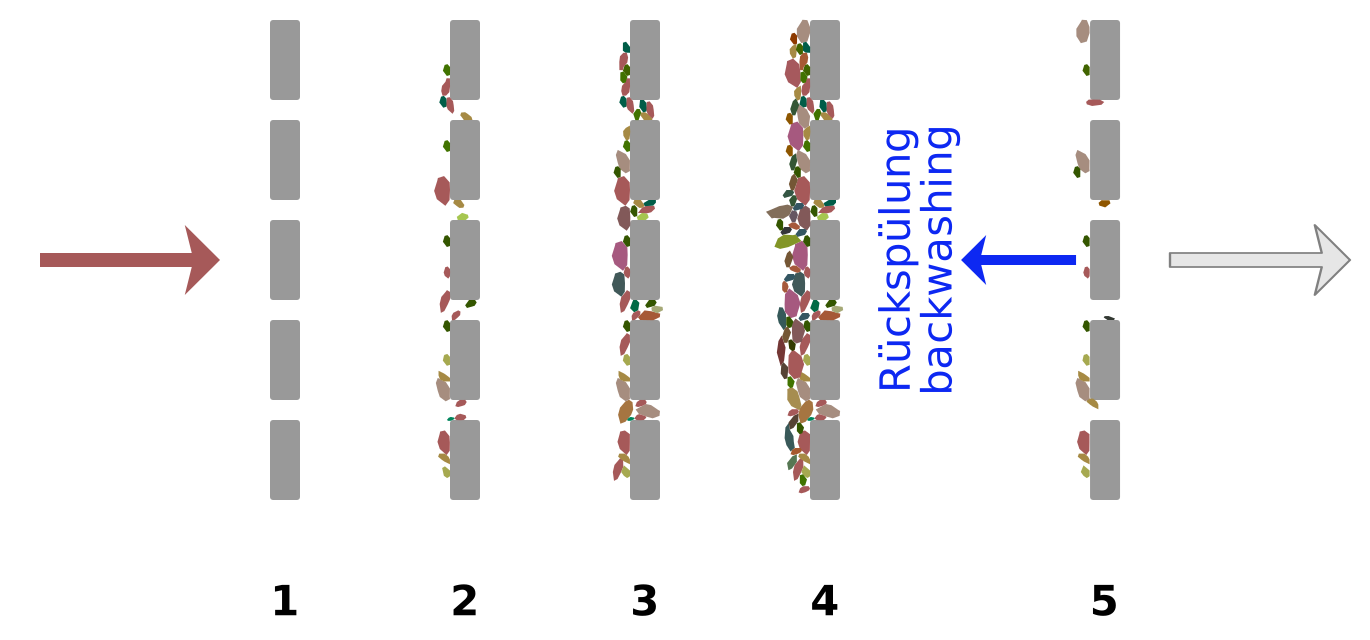
Membrane fouling occurs through several primary mechanisms, often acting in concert. Cake layer formation involves the deposition of suspended solids from the feed stream onto the membrane surface, creating a physical barrier that impedes flow. Pore blocking happens when particles are small enough to enter and obstruct the membrane pores themselves, a common issue in microfiltration and ultrafiltration. Adsorption is the adhesion of dissolved or colloidal substances directly to the membrane material, driven by chemical or physical forces, which can alter surface properties. Scaling refers to the precipitation of sparingly soluble salts, such as calcium carbonate or silica, directly onto the membrane surface, often exacerbated by concentration polarization. Finally, biofouling, a particularly insidious form, involves the growth and accumulation of microorganisms like bacteria and algae, forming a complex biofilm that can secrete extracellular polymeric substances (EPS), further cementing the fouling layer and potentially leading to localized corrosion or membrane degradation. Each type of fouling requires tailored mitigation strategies, from pre-treatment of feed water to specialized cleaning protocols.
📊 Key Facts & Numbers
The economic toll of membrane fouling is staggering, estimated to cost the global water treatment industry billions of dollars annually. In desalination alone, fouling can reduce membrane flux by up to 50% within months of operation, necessitating cleaning cycles that consume significant amounts of energy and chemicals. For instance, a typical reverse osmosis plant might experience a 10-20% increase in energy consumption due to fouling-induced pressure drops. Globally, over 16,000 desalination plants operate, producing an estimated 95 million cubic meters of water per day, a scale where even a 1% increase in operating cost due to fouling translates to tens of millions of dollars. Furthermore, irreversible fouling can lead to membrane replacement every 3-7 years, a capital expense that adds substantially to the cost of treated water, which can range from $0.50 to $3.00 per cubic meter depending on the technology and location. The global market for membrane water treatment is projected to reach over $40 billion by 2028, underscoring the immense scale of operations affected by fouling.
👥 Key People & Organizations
While no single individual can be credited with 'discovering' membrane fouling, numerous researchers and engineers have made pivotal contributions to understanding and combating it. Dr. P.K. (Prabir Kumar) Sengupta, a distinguished professor and researcher, has extensively published on membrane fouling in wastewater treatment and desalination processes, particularly focusing on membrane bioreactors and the role of EPS. Dr. Menachem Elimelech, a renowned expert in environmental engineering at Yale University, has conducted seminal work on the mechanisms of biofouling and scaling in reverse osmosis systems, influencing membrane material design and operational strategies. Organizations like the International Water Association (IWA) and the American Water Works Association (AWWA) regularly host conferences and publish research dedicated to membrane technologies and fouling control. Major membrane manufacturers, including SUEZ Water Technologies & Solutions, Toray Industries, and LG Chem, invest heavily in R&D to develop fouling-resistant membranes and optimized cleaning solutions.
🌍 Cultural Impact & Influence
Membrane fouling has profoundly shaped the trajectory of water purification and industrial separation technologies, acting as both a persistent obstacle and a powerful catalyst for innovation. The economic burden imposed by fouling has spurred the development of advanced pre-treatment methods, such as ultrafiltration and nanofiltration, designed to remove foulants before they reach the primary separation membrane. It has also driven the creation of novel membrane materials with enhanced anti-fouling properties, incorporating surface modifications or using materials like graphene oxide and carbon nanotubes. The need to combat fouling has fostered entire sub-disciplines within environmental engineering and chemical engineering, influencing curriculum design at universities worldwide and shaping the careers of countless researchers. Furthermore, the challenge of fouling has indirectly boosted the adoption of alternative, less fouling-prone technologies in certain niche applications, demonstrating its broad impact on the technological landscape.
⚡ Current State & Latest Developments
The current landscape of membrane fouling research is intensely focused on developing 'smart' membranes and integrated process designs. Researchers are exploring nanotechnology-based solutions, such as incorporating titanium dioxide nanoparticles into membrane structures to create photocatalytic surfaces that can degrade organic foulants under UV light. Advances in artificial intelligence and machine learning are being applied to predict fouling events and optimize cleaning schedules in real-time, moving beyond reactive maintenance to proactive control. Companies like Ostara Nutrient Recovery Technologies are developing innovative approaches to manage mineral scaling, a common fouling issue in wastewater. Furthermore, there's a growing emphasis on 'green' cleaning solutions, seeking biodegradable and less toxic alternatives to traditional chemical treatments, driven by increasing environmental regulations and a desire for sustainable operations. The development of self-healing membranes, capable of repairing minor surface damage that can initiate fouling, is also an active area of investigation.
🤔 Controversies & Debates
The debate surrounding membrane fouling often centers on the trade-offs between performance and cost. One major controversy involves the efficacy and environmental impact of chemical cleaning agents. While powerful chemicals like sodium hypochlorite and sulfuric acid are effective at removing stubborn foulants, their use can degrade membrane materials over time, shorten membrane lifespan, and pose environmental risks if not properly managed. This has led to a push for less aggressive, 'green' cleaning methods, but critics argue these are often less effective against severe fouling, potentially leading to higher operating costs due to reduced flux and more frequent membrane replacements. Another contentious area is the optimal pre-treatment strategy: investing heavily in advanced pre-treatment can prevent fouling but significantly increases capital and operational costs, while insufficient pre-treatment leads to rapid fouling and higher downstream maintenance expenses. Finding the economically optimal balance remains a persistent challenge.
🔮 Future Outlook & Predictions
The future of membrane technology is inextricably linked to overcoming the challenge of fouling. Experts predict a continued surge in the development of fouling-resistant materials, potentially incorporating biomimetic designs inspired by natural filtration systems. The integration of Internet of Things (IoT) sensors and advanced analytics will likely enable 'predictive maintenance' for membranes, allowing operators to intervene precisely when fouling begins to impact performance, rather than relying on fixed cleaning schedules. We can expect to see more modular and decentralized membrane systems, particularly for water reuse and point-of-use applications, where fouling management will be critical for reliability. The ultimate goal for many researchers is the development of 'self-cleaning' or 'fouling-immune' membranes, a paradigm shift that would dramatically reduce the cost and complexity of membrane-based separations, potentially unlocking new applications in fields like pharmaceuticals and advanced materials manufacturing. Projections suggest that by 2035, over 70% of new membrane installations will feature integrated fouling monitoring and control systems.
💡 Practical Applications
Membrane fouling is a critical consideration across numerous industries. In desalination plants, it directly impacts the cost and availability of fresh water, a growing global concern. In wastewater treatment, particularly with membrane bioreactors (MBRs), fouling dictates the energy consumption and sludge disposal costs. The food and beverage industry relies on membranes for processes like milk processing (whey protein concentration) and juice production (clarification), where fouling affects product quality and throughput. The pharmaceutical industry uses membranes for sterile filtration and protein purification, where fouling can compromise product purity and lead to costly batch failures. Even in everyday applications like home water filters, fouling reduces flow rate and necessitates filter replacement. Effective fouling management is therefore essential for the economic viability and operational success of these diverse sectors.
Key Facts
- Year
- Mid-20th Century (modern understanding)
- Origin
- Global
- Category
- technology
- Type
- phenomenon
Frequently Asked Questions
What are the main types of membrane fouling?
Membrane fouling is broadly categorized into four main types: colloidal fouling, caused by suspended particles like clays and flocs; biological fouling (biofouling), involving the growth of microorganisms such as bacteria and fungi, often forming biofilms; organic fouling, due to the adsorption of dissolved organic matter like oils and humic substances; and scaling, which is the precipitation of mineral salts like calcium carbonate directly onto the membrane surface. Each type presents unique challenges and requires specific mitigation strategies, often involving tailored pre-treatment or cleaning protocols.
Why is membrane fouling such a significant problem?
Membrane fouling is a major obstacle because it directly degrades the performance of essential separation technologies. It causes a significant reduction in permeate flux, meaning less clean water is produced over time, and increases the required operating pressure, leading to higher energy consumption. This necessitates frequent and often aggressive cleaning cycles using chemicals that can damage the membranes, or even premature replacement of expensive membrane modules. Consequently, fouling dramatically increases the operational and capital costs associated with processes like desalination, wastewater treatment, and food processing, impacting the economic viability and widespread adoption of membrane technologies.
How can membrane fouling be prevented or managed?
Preventing and managing membrane fouling involves a multi-pronged approach. Pre-treatment of the feed water is crucial, employing methods like sedimentation, coagulation, flocculation, sand filtration, ultrafiltration, or activated carbon filtration to remove foulants before they reach the main membrane. Membrane material selection is also key, with ongoing research into developing membranes with inherent fouling resistance through surface modifications or novel materials. Operational strategies, such as optimizing crossflow velocity to enhance shear forces and implementing periodic backwashing or air scouring, can help dislodge foulants. Finally, effective cleaning protocols, using appropriate chemicals and physical methods, are essential for removing accumulated foulants and restoring membrane performance, though the balance between cleaning effectiveness and membrane integrity must be carefully managed.
What is the difference between reversible and irreversible fouling?
The distinction between reversible and irreversible fouling lies in the ease with which the accumulated material can be removed. Reversible fouling involves foulants that are loosely attached to the membrane surface or pores, and can typically be removed by physical means such as increased shear force (e.g., higher crossflow velocity), backwashing, or mild chemical cleaning. In contrast, irreversible fouling involves foulants that are strongly adhered to the membrane surface, have penetrated pores, or have undergone chemical changes (like precipitation or biofilm formation) that make them difficult to dislodge. Irreversible fouling often requires more aggressive chemical cleaning, can permanently reduce membrane performance, and may ultimately necessitate membrane replacement.
How does biofouling differ from other types of fouling?
Biofouling is distinct because it involves the growth and accumulation of living microorganisms, such as bacteria, fungi, and algae, on the membrane surface. Unlike inert particle deposition or mineral precipitation, biofouling is a dynamic process where microbes attach, proliferate, and secrete extracellular polymeric substances (EPS). This EPS matrix acts as a glue, trapping other foulants and creating a complex, often slimy, biofilm. Biofilms can significantly reduce flux, increase pressure drop, and, in some cases, lead to localized membrane degradation or corrosion. Managing biofouling requires strategies that target microbial activity, such as disinfection or the use of antimicrobial membrane materials, in addition to conventional fouling control methods.
What are the economic implications of membrane fouling?
The economic implications of membrane fouling are substantial, impacting both capital and operational expenditures. Operationally, fouling leads to increased energy consumption due to higher operating pressures, greater use of chemicals for cleaning, and more frequent maintenance. Capital costs are affected by the need for more robust pre-treatment systems and the eventual replacement of fouled membranes, which can be a significant expense. For example, in desalination, fouling can increase the cost of producing freshwater by 10-30%. Globally, the cumulative cost of membrane fouling across various industries is estimated to be in the billions of dollars annually, making fouling mitigation a critical factor in the economic feasibility of membrane-based processes.
What are the latest innovations in combating membrane fouling?
Recent innovations focus on creating inherently fouling-resistant membranes and smarter operational control. This includes developing membranes with superhydrophobic or zwitterionic surfaces that repel foulants, incorporating nanoparticles like titanium dioxide for photocatalytic self-cleaning, and designing 'smart' membranes that can signal fouling levels. Advanced pre-treatment technologies, such as electrodialysis and enhanced ultrafiltration, are also gaining traction. Furthermore, the application of artificial intelligence and machine learning for predictive fouling modeling and optimized cleaning schedules is a rapidly growing area, aiming to shift from reactive to proactive fouling management. Research into biodegradable and environmentally friendly cleaning agents is also a key trend.