
Contents
- 🎯 Introduction to Perception
- 👀 Theories of Perception
- 📊 Key Factors Influencing Perception
- 🌍 Cultural and Social Influences on Perception
- ⚖️ Perception in Real-World Applications
- 🤔 Controversies and Debates in Perception Research
- 🔮 Future Directions in Perception Studies
- 📚 Related Topics and Further Reading
- References
Overview
The psychology of perception is a multifaceted field that explores how we organize, identify, and interpret sensory information to understand our environment. This complex process involves not only the passive receipt of signals but also the active shaping of these signals by our learning, memory, expectation, and attention. The study of perception has its roots in ancient Greece, with philosophers like Plato and Aristotle pondering the nature of reality and how we come to know it. Today, the psychology of perception continues to influence fields such as artificial intelligence, marketing, and education, with applications ranging from improving user experience to enhancing learning strategies. As research advances, we are reminded that perception is a dynamic and highly subjective process, influenced by a myriad of factors including cultural background, emotional state, and personal beliefs. With a deeper understanding of perception, we can better navigate the complexities of human interaction and develop more effective strategies for communication and collaboration.
🎯 Introduction to Perception
The study of perception has its roots in ancient Greece, with philosophers like Plato and Aristotle pondering the nature of reality and how we come to know it. However, the field of psychology began to take shape, with the establishment of the first psychology laboratory. This marked the beginning of a systematic approach to understanding the human mind and behavior, including the complex processes of perception. Today, perception is recognized as a critical aspect of human psychology, influencing everything from our decision-making processes to our social interactions.
👀 Theories of Perception
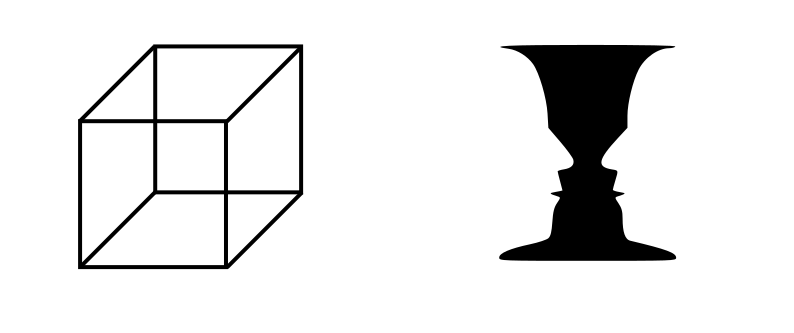
Theories of perception abound, each attempting to explain how we transform sensory input into meaningful information. The Gestalt theory, for example, posits that our brain organizes visual information into patterns and shapes, while the constructivist theory suggests that we actively construct our perception of reality based on past experiences and expectations. Other influential theories include the bottom-up processing approach, which emphasizes the role of sensory input in shaping perception, and the top-down processing approach, which highlights the influence of cognitive biases and expectations.
📊 Key Factors Influencing Perception
A multitude of factors influence our perception, including attention, expectation, and past experiences. For instance, the von Bezold-Brücke effect demonstrates how our perception of color can be influenced by the surrounding context, while the Müller-Lyer illusion shows how our brain can be tricked into misperceiving the length of lines. Additionally, cultural background and social influences can significantly impact our perception, as evidenced by the hollow face illusion, which is more pronounced in individuals from Western cultures. Understanding these factors is crucial for developing effective strategies in fields like advertising and education.
⚖️ Perception in Real-World Applications
The psychology of perception has various applications. By understanding how we perceive and interpret sensory information, designers can create more intuitive and user-friendly products. Furthermore, the study of perception can inform strategies for improving learning outcomes and decision-making processes.
🤔 Controversies and Debates in Perception Research
Despite the significant advancements in perception research, controversies and debates persist. The nature vs. nurture debate, for example, raises questions about the relative contributions of genetic and environmental factors to our perceptual abilities. Additionally, the free will vs. determinism debate sparks discussions about the extent to which our perceptions are influenced by conscious decision-making or unconscious processes.
🔮 Future Directions in Perception Studies
As research continues to advance, new directions in perception studies are emerging. The neural correlates of consciousness, for instance, is an area of research that seeks to understand the neural mechanisms underlying conscious perception.
Key Facts
- Category
- psychology
- Type
- concept