
Contents
- 🚀 What is Implementation Science?
- 🎯 Who Needs This Knowledge?
- 🗺️ The Core Problem It Solves
- 💡 Key Concepts & Frameworks
- 📈 Measuring Success: Beyond the Lab
- 🚧 Common Roadblocks & How to Navigate Them
- 🤝 Bridging the Divide: Collaboration is Key
- 🌐 Global Impact & Future Directions
- Frequently Asked Questions
- Related Topics
Overview
Implementation science is the systematic study of methods, strategies, and policies used to promote the uptake of research findings and evidence-based practices into routine practice. It's the crucial bridge that ensures innovations don't just sit in academic journals but actually improve lives and systems. Think of it as the 'how-to' manual for making change stick, focusing on the practical challenges of adoption, adaptation, and sustainability. This field grapples with why effective interventions fail to be implemented, identifying barriers and facilitators to ensure that what works in controlled settings can be successfully applied in complex, real-world environments. It's less about what works and more about how to make it work, for whom, and under what conditions.
🚀 What is Implementation Science?
Implementation science is the rigorous, systematic study of methods and strategies that facilitate the uptake of research findings and evidence-based practices into real-world settings. It's not just about discovering what works, but about understanding how to make it work consistently and at scale. Think of it as the engineering discipline for social change, translating promising discoveries from controlled environments into tangible benefits for communities. This field is crucial for maximizing the return on investment in research, ensuring that valuable knowledge doesn't languish in academic journals but actively improves lives in areas like public health and education.
🎯 Who Needs This Knowledge?
This knowledge is indispensable for a broad spectrum of professionals. Public health officials, policymakers, program managers, and frontline practitioners in healthcare, education, and social services all stand to gain. Researchers themselves benefit by learning how to design studies that are more amenable to real-world application. Even those in the private sector, particularly in fields like organizational development and change management, can apply its principles to drive effective adoption of new strategies and technologies. Essentially, anyone tasked with translating evidence into action needs a solid grasp of implementation science.
🗺️ The Core Problem It Solves
The fundamental problem implementation science addresses is the persistent and often vast 'know-do gap.' Decades of research have yielded effective interventions for numerous societal challenges, yet their widespread adoption and sustained use in practice remain stubbornly low. This gap represents a massive loss of potential impact and wasted research resources. Implementation science provides the tools and methodologies to systematically diagnose why interventions fail to translate and to develop strategies that overcome these barriers, ensuring that evidence-based solutions actually reach the people who need them most, from childhood obesity prevention to mental health services.
💡 Key Concepts & Frameworks
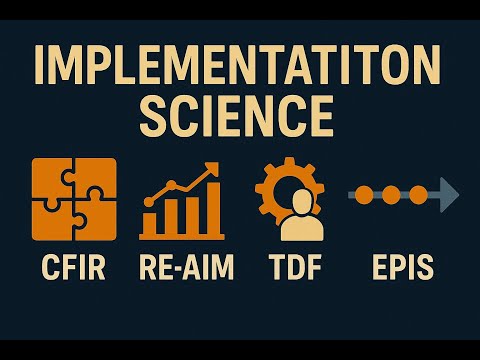
At its heart, implementation science utilizes a variety of frameworks and concepts to dissect the process of adoption. Key among these are implementation strategies—specific actions designed to increase the likelihood of a program or policy being adopted, adapted, and sustained. Frameworks like the Consolidated Framework for Implementation Research (CFIR) and the RE-AIM model offer structured ways to assess factors influencing implementation, such as organizational readiness, policy environments, and fidelity of implementation. Understanding these conceptual tools is vital for designing effective implementation plans.
📈 Measuring Success: Beyond the Lab
Measuring success in implementation science goes far beyond traditional efficacy or effectiveness trials. While those are important starting points, implementation science focuses on outcomes like reach (the proportion of the intended population that receives the intervention), adoption (the extent to which practitioners use the intervention), implementation fidelity (the degree to which the intervention is delivered as intended), maintenance (the sustainability of the intervention over time), and adaptation (the extent to which the intervention is modified to fit the local context). These metrics provide a more comprehensive picture of real-world impact.
🤝 Bridging the Divide: Collaboration is Key
Effective implementation is rarely a solo endeavor; it demands robust collaboration between researchers, practitioners, policymakers, and the communities they serve. This interdisciplinary collaboration ensures that research is relevant to real-world needs and that implementation strategies are practical and contextually appropriate. Building strong partnerships fosters shared ownership and can accelerate the translation of evidence into sustainable practice. Initiatives like learning collaboratives exemplify how diverse groups can work together to solve complex implementation challenges.
🌐 Global Impact & Future Directions
The principles of implementation science are gaining traction globally, recognized as essential for achieving ambitious public health and social development goals. As the field matures, there's a growing emphasis on developing scalable and sustainable implementation strategies that can be applied across different settings and populations. Future directions include leveraging digital health technologies for dissemination and monitoring, refining methods for adapting evidence-based interventions to diverse low-resource settings, and further integrating implementation science into the core training of researchers and practitioners alike. The ultimate aim is to create systems that are inherently designed for continuous improvement and effective impact.
Key Facts
- Year
- 2000
- Origin
- Emerged from a recognized gap between the generation of research evidence and its consistent application in practice, particularly in fields like public health, medicine, and social services. Early work by figures like Dean Fixsen and Karen Bartholomew in the early 2000s helped formalize the field.
- Category
- Social Sciences / Public Health / Policy
- Type
- Academic Field / Methodology
Frequently Asked Questions
What's the difference between implementation science and traditional research?
Traditional research often focuses on establishing efficacy (does it work under ideal conditions?) or effectiveness (does it work in a specific real-world setting?). Implementation science, however, focuses on the process of getting those proven interventions adopted, used, and sustained by practitioners and organizations. It asks 'how do we make it happen?' rather than just 'does it work?'
Is implementation science only for health-related fields?
While implementation science has deep roots and significant application in public health and healthcare, its principles are widely applicable across many domains. This includes education, social work, criminal justice, environmental management, and even business strategy, anywhere that evidence-based practices need to be translated into widespread, sustained action.
What are some common implementation strategies?
Common strategies include stakeholder engagement to build buy-in, training and technical assistance to build capacity, audit and feedback to monitor performance, policy and economic incentives to encourage adoption, and tailoring interventions to fit local contexts. The choice of strategy depends heavily on the specific intervention and the context of implementation.
How do you measure the success of an implementation effort?
Success is measured using metrics beyond just intervention outcomes. Key indicators include reach (who is being served), adoption (how widely it's being used), fidelity (how well it's being delivered as intended), and sustainability (whether it continues over time). The RE-AIM framework is a popular model for tracking these dimensions.
What is the role of context in implementation science?
Context is paramount. Implementation science recognizes that interventions don't exist in a vacuum. Factors like organizational culture, political climate, socioeconomic conditions, and community needs all profoundly influence whether an intervention can be successfully implemented and sustained. Understanding and adapting to context is a core skill.
Where can I learn more about implementation science frameworks?
Several widely used frameworks exist, including the Consolidated Framework for Implementation Research (CFIR), the Reach Effectiveness Adoption Implementation Maintenance (RE-AIM) model, and the Implementation Research Logic Model. Many universities and research centers offer courses, workshops, and online resources dedicated to these frameworks and their application.